
Ingredient Transparency: Beauty to Beverage
Written by our founder, Meredith.
Written by our founder, Meredith.
The founding principals of The Original Southside (as well as any future company innovations…) are:
(1) Do one thing, and one thing well: gin.
(2) Redefine the ready-to-drink cocktail experience by reviving timeless drinks with modern, better-for-you twists.
As most of you know, I started my career in the beauty industry. More specifically, the prestige skincare industry with an emphasis on restricted ingredients like NAD+, NMN, Salicylic Acid, Tretinoin/Retinol, the list goes on. You can read more about this ori-gin story here.
Fun Fact: Beauty is not too dissimilar to the world of beverage / beverage alcohol given the labelling, manufacturing requirements, and laws that need to be followed. Did I know this going in? No. Am I glad this is the case? Yes.
As a bev alc “outsider”, my observation was that the industry was riddled with bad practices and bad ingredients. This serves as the inspiration for this week’s post.
When you walk into Ulta, Target, Sephora or when you’re shopping on Amazon, it’ is understood that you will be able to see the INCI List (AKA International Nomenclature of Cosmetic Ingredients) on a product’s packaging. This is the loooong list of ingredients you find on all of your products.
Nowadays, in addition to your desired formulations and key ingredients, you also expect to see all sorts of additional certifications like cruelty free, leaping bunny/PETA certified, vegan, organic and more. I personally like to buy and use beauty products that are “clean” by Sephora and/or the EU’s standards.
When you walk into a liquor store, these same rules do not apply. Think of the last time you picked up a bottle of your alcohol of choice or box of canned cocktails and saw the ingredient list? The answer is likely never.
In the US, the Alcohol and Tobacco Tax and Trade Bureau (TTB) does NOT require canned cocktails (or any alcohol/alcoholic beverages for that matter) to list what is inside. This means that many of your go-to spirits, beers, and ready-to-drink (RTD) cocktails could be loaded with things like artificial flavors, hidden sweeteners, artificial preservatives, stabilizers, genetically modified ingredients, and so much more.
Moreover, it also somehow allows beverages made with malt liquor (not a real spirit) to market themselves as cocktails with names like “Ranch Water”, “Margarita”, etc. when they are, in fact, not really those cocktails.
Many brands take advantage of these loopholes and count on the fact that most consumers won’t ask questions, because — frankly — most people don’t even realize they should be asking.
I am even guilty of this! On our first production run, we didn’t list the nutrition fact panel on our primary (can) or secondary (4-pack) packaging. I figured if people really wanted to know, they’d check our website, where the info has always been available.
But then…
(1) Our consumers asked for it.
(2) I realized we had nothing to hide and that this could actually be to our benefit.
Emphasis on dirty. As mentioned, the TTB does not require canned cocktails (or any alcohol/alcoholic beverages) to list what is inside. The TTB also does not allow you to promote if your product is non-GMO.
That makes no sense, right? Other products in food + non-alcoholic beverage actively want to see products that are non-GMO. So why is this the case? I’ll let you Google and do your own research to come to your own conclusions. *wink*
If you’ve spent any time online lately, you’ve probably seen the rise of the Make America Health Again (MAHA) movement. This movement is led by a combination of the MAHA PAC and individuals like Calley and Casey Means, Vani Hari (“Food Babe”), Mark Hyman, and Jason Karp to name a few. Most interestingly though is the following of moms who are fed up with the food industry and their use of artificial dyes and other ingredients that are not used in their European / international formulas specifically targeted at children. Kellogg’s was their first target, and now these individuals are taking total nutrition reform in key states like Texas, one government meeting at a time.
Why am I providing this context and background? Consumers demanded a removal of Red 3, Yellow 5, etc. and we’re seeing it start to happen. Consumers demanded the removal of seed oils and we’re seeing it start to happen.
This same pressure could be coming for the alcohol industry over the next few years. If consumers are scrutinizing both their beauty and food labels, why should cocktails and alcohol get a free pass?
It has already been established that the beauty and skincare industry does ingredient transparency and storytelling like no other. The alcohol industry is proving to be quite different.
In my opinion, a good example of this is what tequila brands are going through at the moment. If you’ve seen the rise of “additive-free” tequila, you might assume that brands are allowed to proudly display that claim. Here’s the catch - you guessed it - they’re not. I’m not going to pretend I know all the nuances here, I’m no expert. That said, there are certain tequila brands that make their tequilas with glycerin, caramel coloring, and sugar based syrups and others that are just the good stuff.
Recently the “Consejo Regulador del Tequila” (CRT) filed a lawsuit against the Additive Free Alliance. Transparency is coming, but there are active fights against it.
Having nutrition facts / labels and full ingredient lists should be required for all food and beverage products. Full stop. It allows consumers to make the most educated decision and brings to light the exactly what is being used.
This Vox article from 2015 discusses in more detail the lack of nutritional labeling on alcoholic beverages and why it is the way that it is. There have been at least 6 times consumer advocate groups have tried to get the federal government to require more comprehensive labels on all alcohol… all of which were thwarted by alcohol manufacturers.
Vice swapping is real, people! We often get asked about the sugar content (11g per serving) in The Original Southside. To put this quantity into perspective, here’s a chart of some popular RTD beverages (alcoholic, non-alcoholic, THC, and “mocktail”) compared to popular fruits and other grocery items.
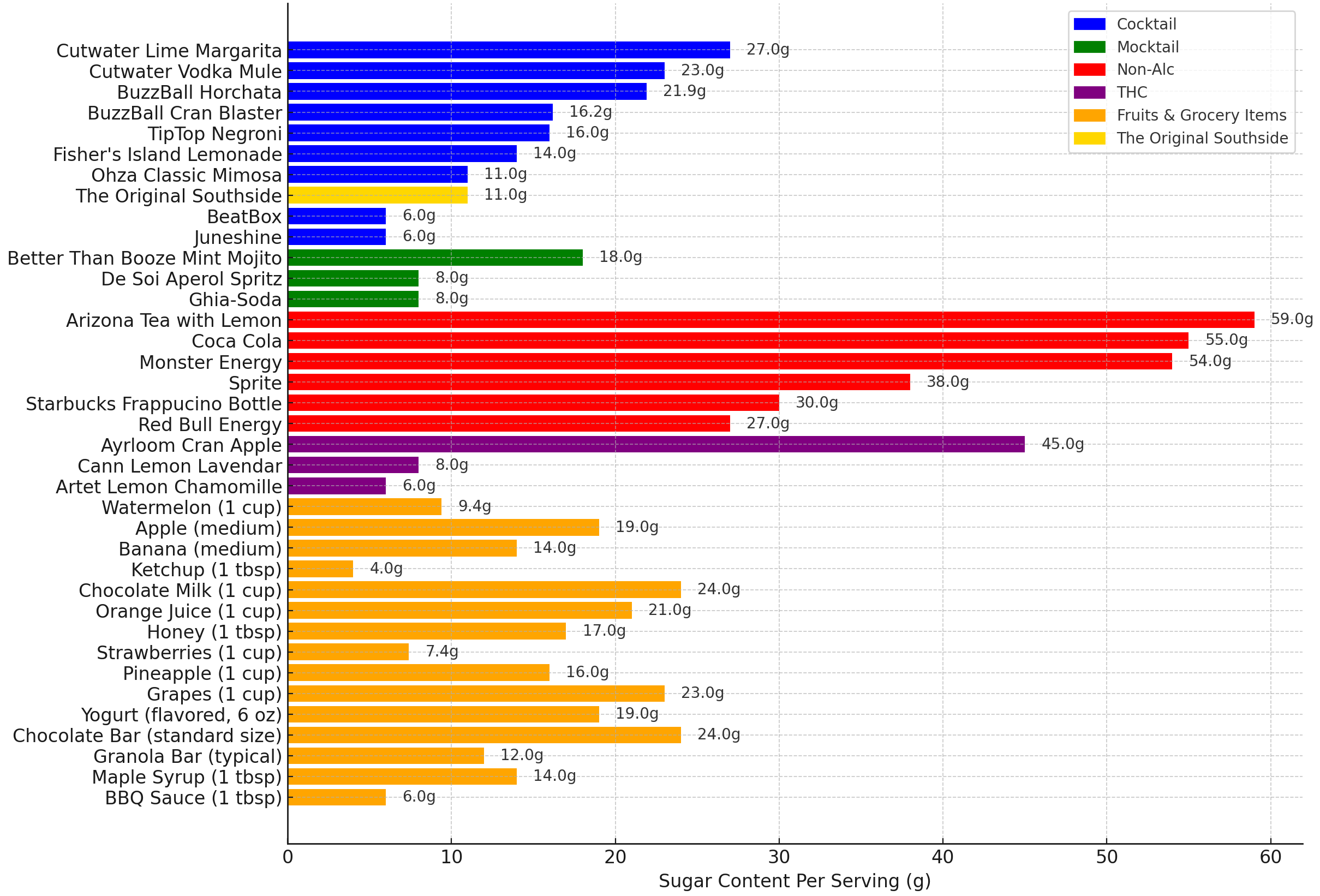
The goal of this is to challenge the idea that non-alcoholic beverages and mocktails are inherently “healthier” or “better” options. Removing alcohol doesn’t automatically make a drink better for you. While there are many reasons people choose non-alcoholic options, this discussion focuses solely on ingredients—not sobriety, addiction or the like.
**Disclaimer: These sugar content values are based on publicly available information as of March 2025. Actual values may vary by brand, formulation, and/or serving size. Always check product labels or websites for the most accurate and up-to-date nutritional information.**
Personally, I think what is inside your consumable products should not be a surprise. A great cocktail shouldn’t be a mystery. Modern products should not rely on undisclosed additives, synthetic flavors, or marketing “tricks” (a la malt Ranch Waters) to hide what’s really inside.
You deserve to know what’s in your drink and then make the choice. Next time you go to pick up your favorite drink or canned cocktail brand you can ask yourself: Do I know what’s inside? If they’re not telling you, there’s more than likely a reason why.
If consumers care about what is in their skincare/beauty products and what is in their food, why wouldn’t they care about a better for you approach to spirits / beer / wine / canned cocktails?
This isn’t to sway you one way or another on Southsides, it’s to bring to light the internal decisions that are made to continue to commit to ingredient transparency.
Instead of choosing a cheaper, easier formulation of my family recipe, we went a different route. We will continue to operate in this manner and hold true to our north star, Do one thing, and one thing well: gin.
Thanks for reading. Would love to hear your questions, comments, complaints, etc. This was quite the diatribe, but passion is good…right?
Cheers,
M


